
summer's whisper: you can never be "too late."
on chronopolitics and aftershocks.

I was working these past few months to get a short story out in the world from a manuscript I’d been working on with an editor in between a fellowship I had at USC back in 2019. I’d been to L.A. several times before that, but I was there for most of the summer that year, which was the longest time I’d spent in the city. Part of me was wondering if I was going to call it home, despite my fear of earthquakes.
Within a few days of being there, I experienced the largest earthquake the state had in 20 years (the Ridgecrest quakes). A friend’s mother who served as my proxy to find me an apartment while I was still back in Philadelphia and had generally taken me under her wing while out west wrote to me to make sure I was okay—I told her I’d been in a yoga class in an old temple, right under a chandelier. We’d all run outside together, which is apparently not what you’re supposed to do, but is indeed what we did. For the second earthquake of the series, I’d been in bed, convinced the floor was moving due to my jet lag.
I had a big bedroom at the front of a house near the campus and my roommate was often at her boyfriend’s place, so I usually had the big round kitchen table to myself where I iced coffee and worked on the pieces. I’d left my dog with my family back in New York and often felt the guilt of not being the one to take him on walks, but I savored my uninterrupted hours—once, even a whole weekend I spent simply listening only to my body about when to eat and when to sleep and when to write—it’s a feeling I’ve only had a few other times when I’ve gone on residencies, where you can slip into the unknown untethered and unaccountable. Where times becoming mushy and you can let go of the expectations you hold for yourself or others place on you.
I’ve been in a reading group this summer centered on chronopolitics and thinking in particular about how the tracking of time impacts not only behavior but what one thinks possible for themselves or their own lives. The “ticking clock” is more than metaphor, it enacts pressure, it’s a little dictator. By restricting time through the construction of a domineering linearity used to impose deadlines or orders, lives and imaginations are controlled. We lose connection to our senses and intuitions. Whoever centralizes time determines whose has run out. Like what has been done to indigenous populations, when you are not allowed by executive order or industry to honor the rhythms of how one moves, grows, or lives regardless of a spinning clock on the wall, cultures are sucked dry and at times “made into history.”
But whether you look at time cyclically or linearly, time does “pass,” and growth occurs, which is to say a change occurs. Think of tree’s leaves pressing open or an infant moving up onto their feet. Something has shifting, whether that’s a response to sunlight increasing and sugars metabolizing or a series of hormonal and neurological shifts, there is a sense of contrast between states.
Which reminds me of the aftershocks of the Ridgecrest earthquakes. How each wave of them is like when you move or edit one line or one detail in a story, some feel huge and will knock a wall down, others nearly imperceptible, just a slight rocking under your feet. Still, each draft, each revision, contains the echo of that change, those cumulative shiftings, until something new is sculpted. Those small movements are actually what create form, and so out of time, even what seems “a long time,” new life can be cultivated. Instead of checking a calendar, we might ask ourselves: Are things different? Do they feel different? Is it “time”? From that view, you can never be “too late.”
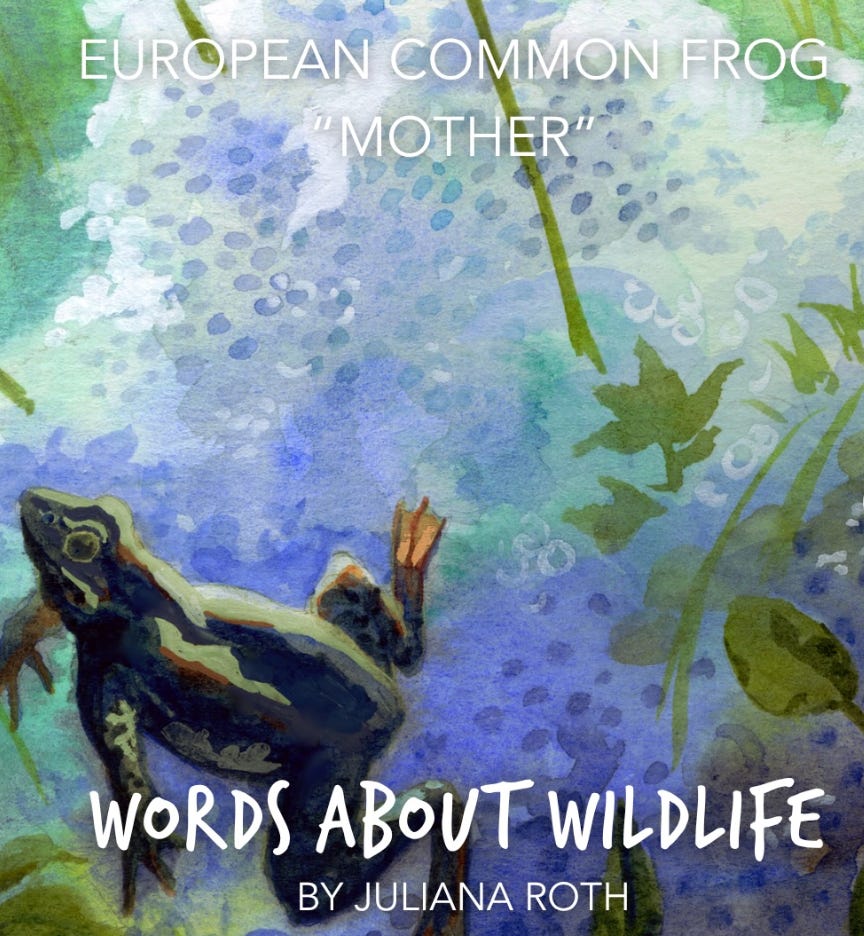
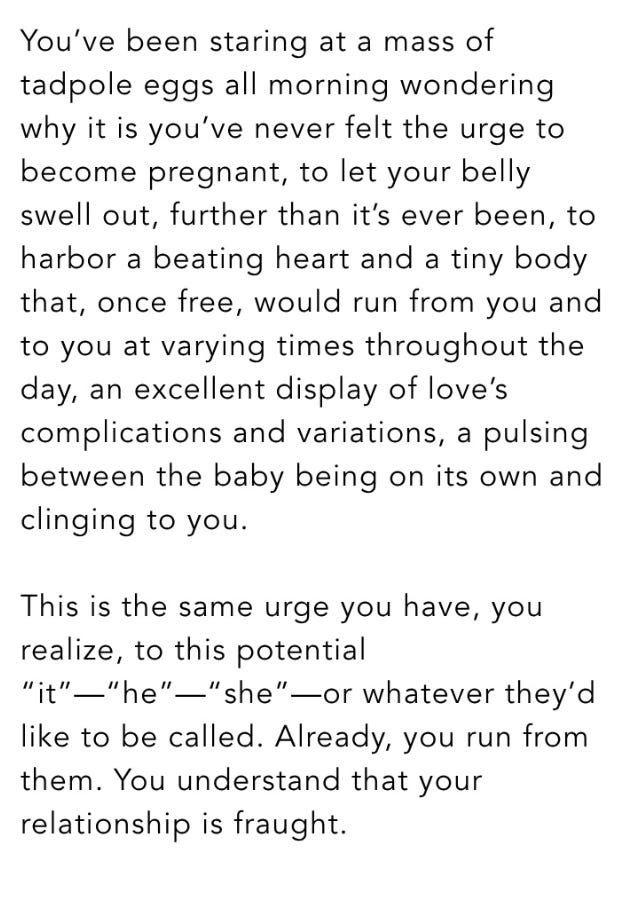
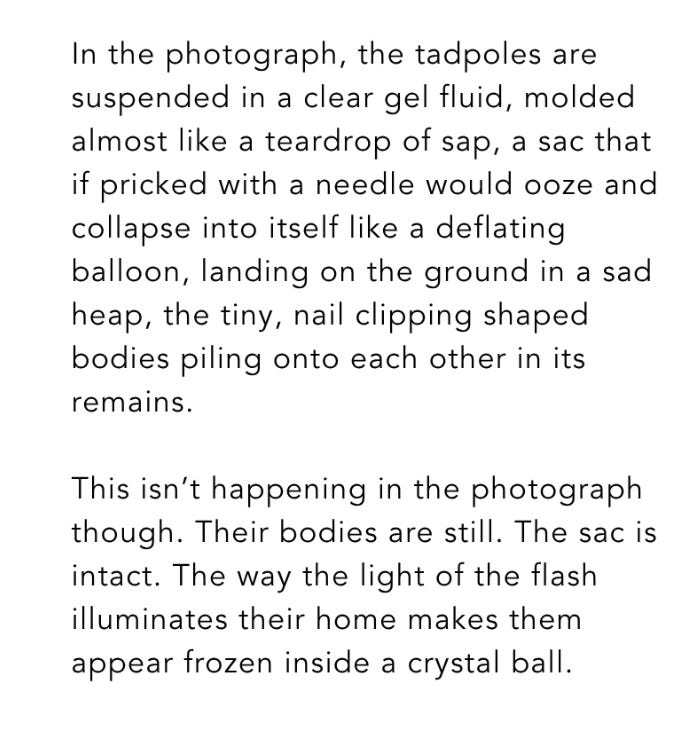
I often collaborate with a wildlife conservation group called Creature Conserve, and earlier this year they asked if I had anything for their Words About Wildlife series. I went back to that pile of short stories from my L.A. summer, remembering a piece I’d done around then on tadpoles and frogs and motherhood. I got to work with the Rokia Whitehouse who made a gorgeous illustration for the story, one where a me, sunburnt and annoyed I couldn’t walk anywhere and filled to the brim with fresh fruit and avocados and marked by “time” as 27, was casting the question of birth out into the future for herself to return to—
<3
j