

self-portraiture
on the fiction of "human," aerobes, and networks.

Shigeko Kubota’s Jogging Lady is up at the New Museum, which I got to see this past weekend. I’d been wanting to go since they reopened last month—the piece is part of their exhibit “New Humans: Memories of the Future.”
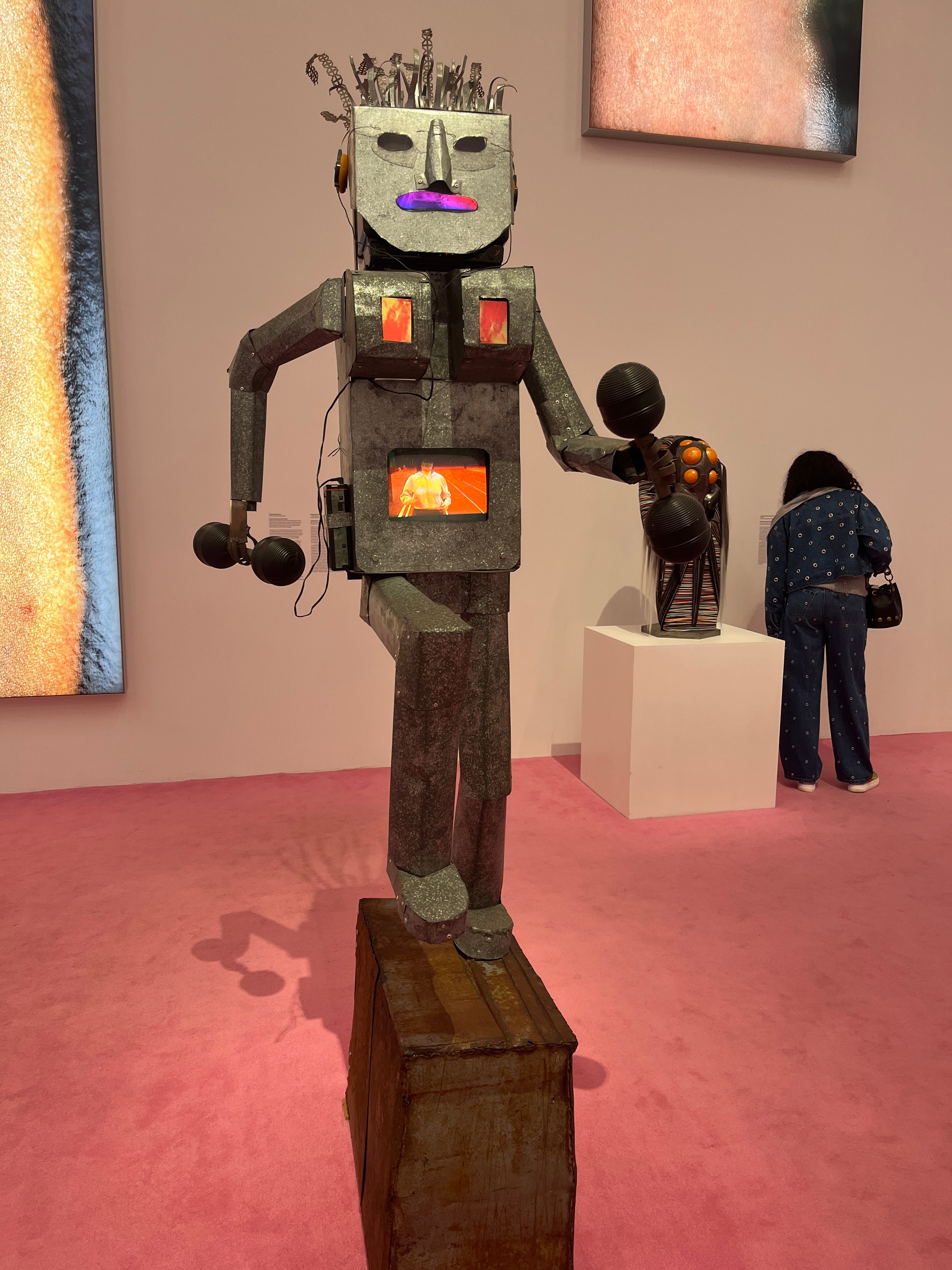
I was drawn to the levity of Kubota’s sculpture—so much of the artwork in the exhibit is powerful, inciting, questioning. I know there’s a lot of reasons to fear / hate / hide from technology and imagine from that vision techno-disasters through both our theory and our art-making, but I fear at times positions like this, while valid and accurate in scope, can become not only a self-fulfilling prophecy, but also limit design and collaborative possibilities.
Kubota was making art largely from the 1960s-90s when analog video ran counter to the hyper-perfection of Hollywood and the purity of “film” as a distinct medium. She integrated video as possible for a multimedia palette—her robot sculpture loops video of her jogging, allowing what may feel a disparate form (video) to integrate into the shape of her self-portrait (as one of the many hardworking women who approach their body as a technology to be perfected / transformed / harnessed / maintained).
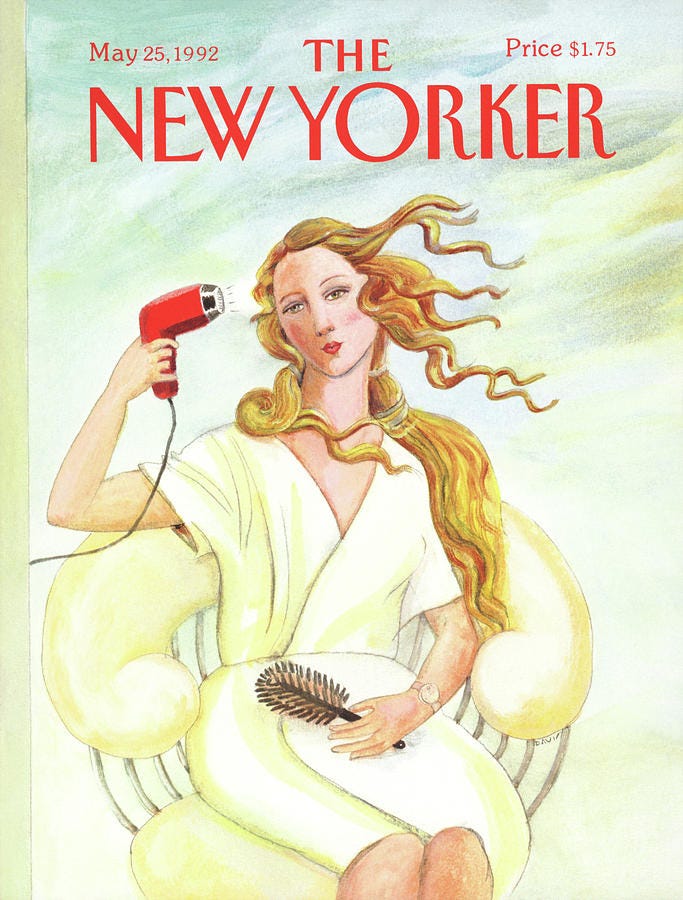
She said she was inspired by The New Yorker’s 1991 Mother’s Day cover for the sculpture, so I had to look it up, and after was curious to see the cover for the year I was born in ‘92. Both seem to be in conversation with Kubota’s piece and feature a technology whether that be a hairdryer or a walkman, which motivate these women towards an idealized gaze. Both feature women (particularly a “mother”) who are almost unreal in their portrait—inhuman if you may—one a statue and the other a god (forget the dumpy (witchy?) artist woman walking in the background who looks like she’s going to be crushed by the superhuman Mommy).

After, I spent the rest of my visit immersed in Christopher Kulendran Thomas’ The Finesse.
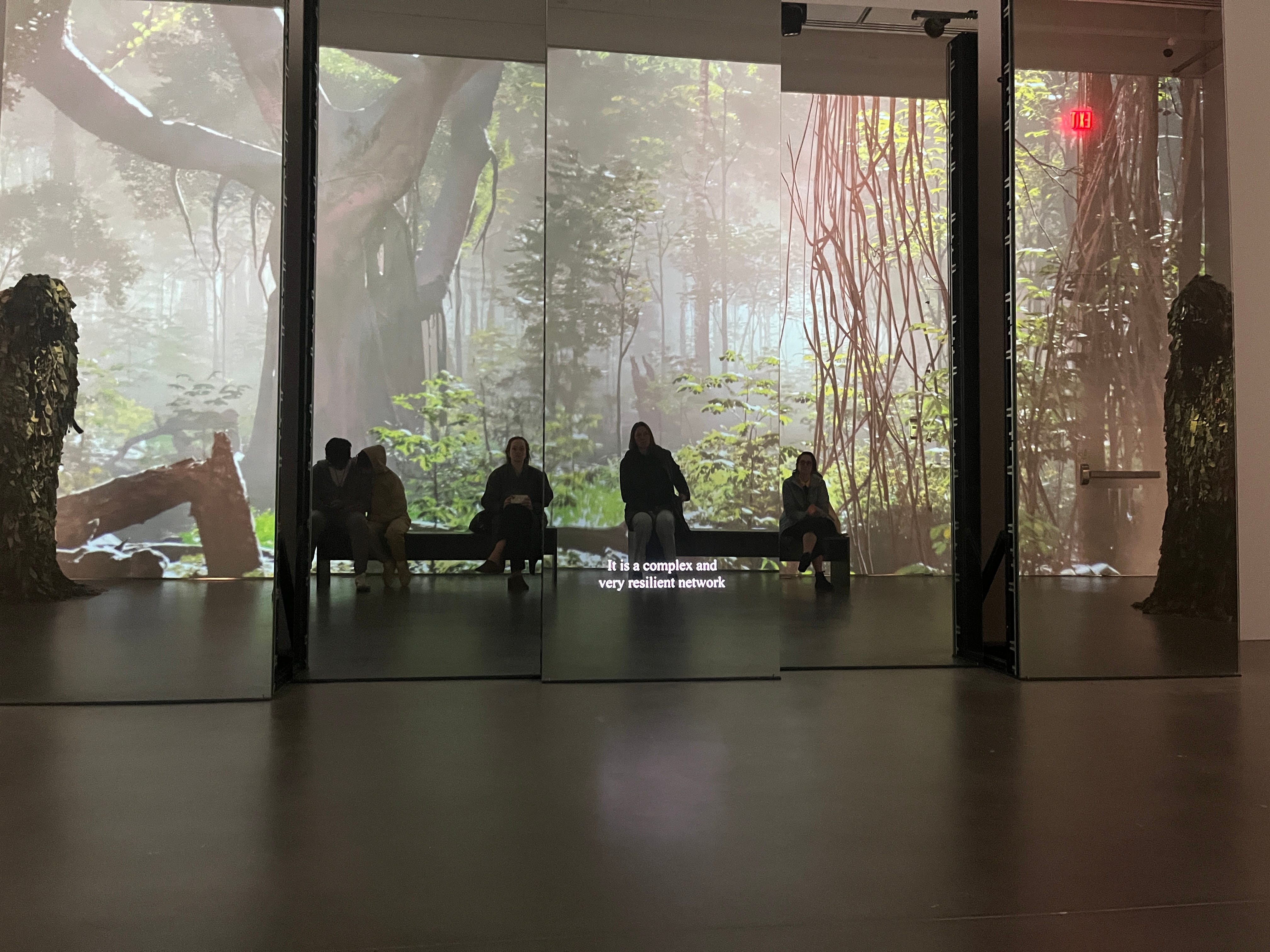
Building off of artists like Kubota using video to collaborate with other forms of art-making, this piece was particularly invitational to the audience as it is projected onto mirrored screens with sculptures around the room. The drama of the film’s pauses whether in natural landscapes or at time full blacked out screens considers the gaze of not only the filmmaker but also you watching, and, you watching yourself, in particular you watching yourself in public, being watched.
The argument of this public self-making is built out explicitly in the story of the film—a chronicle of the Tamil liberation movement, an imagining of a more pluralistic governing, a self-determination within government and community, and a manifesto of what true communal living could be.
To say it plain: it was really cool and I liked it.
He also integrates the story-making of the O.J. Simpson trial (happening around the same time Kubota was sculpting) and the unfixedness of truth evident in its unfolding, highlighted by the use of a deep fake Kim Kardashian as narrator dissecting the identity politics of the trial.
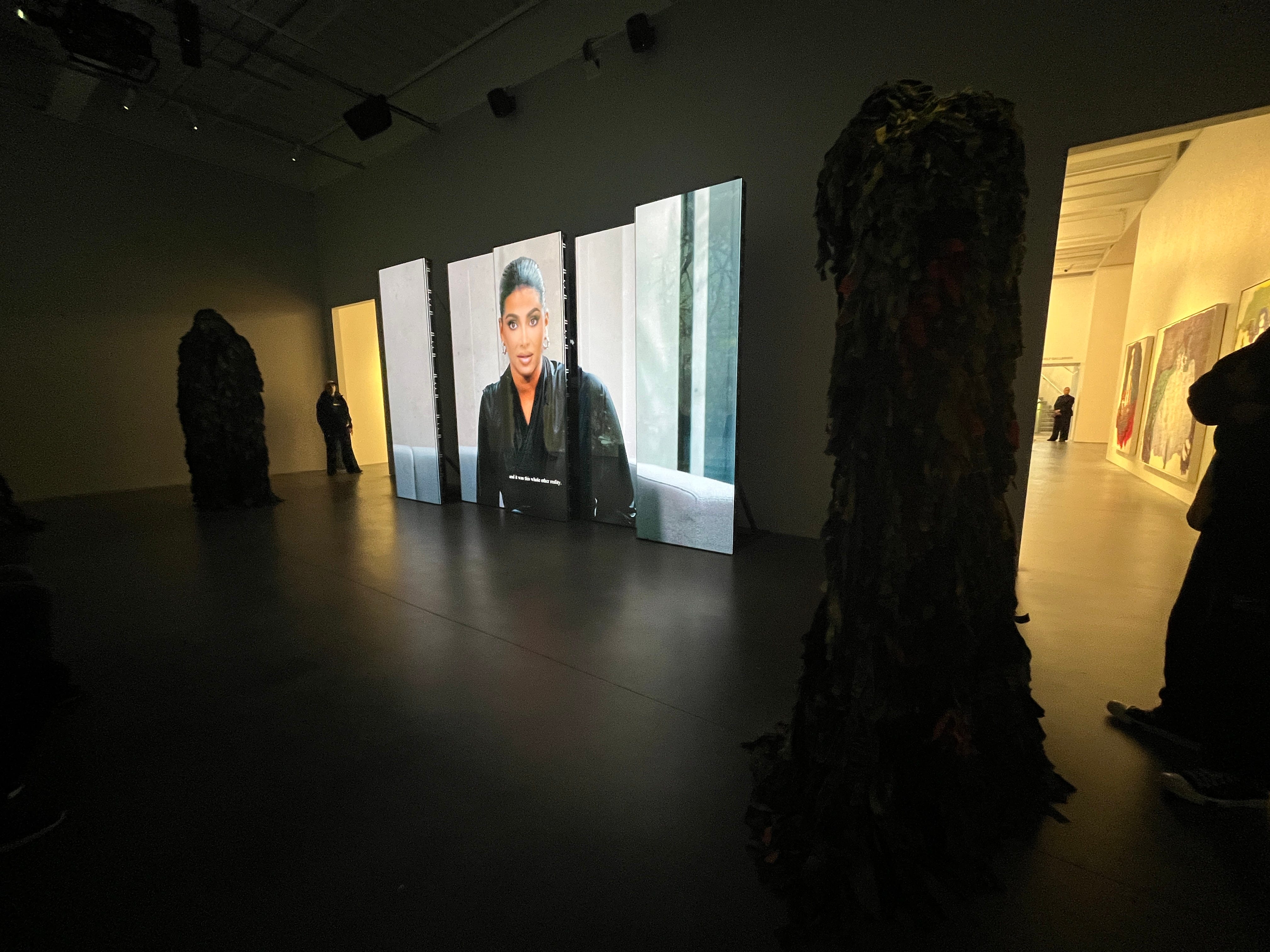
There’s a great interview with him in Gagosian in which he states:
“I’m quite infatuated with that idea of the individual, the idea that we are human and ontologically distinct to everything that’s not human. I think maybe that idea is the foundational psyop of our civilization in that it’s the fiction upon which everything else is based: our economy, our political system, our culture. But the thing about growing up between two different cultures is that it’s easier to see through both. While I’m certainly infatuated with that idea of the individual—perhaps one of the greatest stories ever told—I also don’t entirely believe it. My paintings have become, for me, a way of seeing through that fiction.”
If we just start with us (well, me, I suppose) here in the United States there’s a particular legacy of the importance of proving oneself as part of the category of human in order to necessitate a (supposed) protection from state sanctioned harm, a lack of status of which extends to justifying everything from genocide to slavery to rape, and is so obviously still part of the discourse whether it’s a rationalization like “she’s somebody’s sister so you shouldn’t have roofied her” to “he got good grades so the cops were wrong in shooting him,” all of that language assumes the need to prove oneself as part of a certain class in order to be protected / valued / seen.
So, destabilizing the idea of the class of “human” rightly worries activists who have spent lifetimes battling for barebones recognition, but artists like Kulendran Thomas are ultimately looking, it seems to me, to the political and social consequence of using the category of “human” as distinction as ultimately a philosophical foundation on which harm may continue to flourish and suggests for us, as these special humans, to stand outside the flow of an ecological system rather than within. The alternate would view all entities as interconnected in their distinction rather than as part of a hierarchic system of superiority with incompatible needs whose competition is endless rather than resolvable and ultimately collaborative.
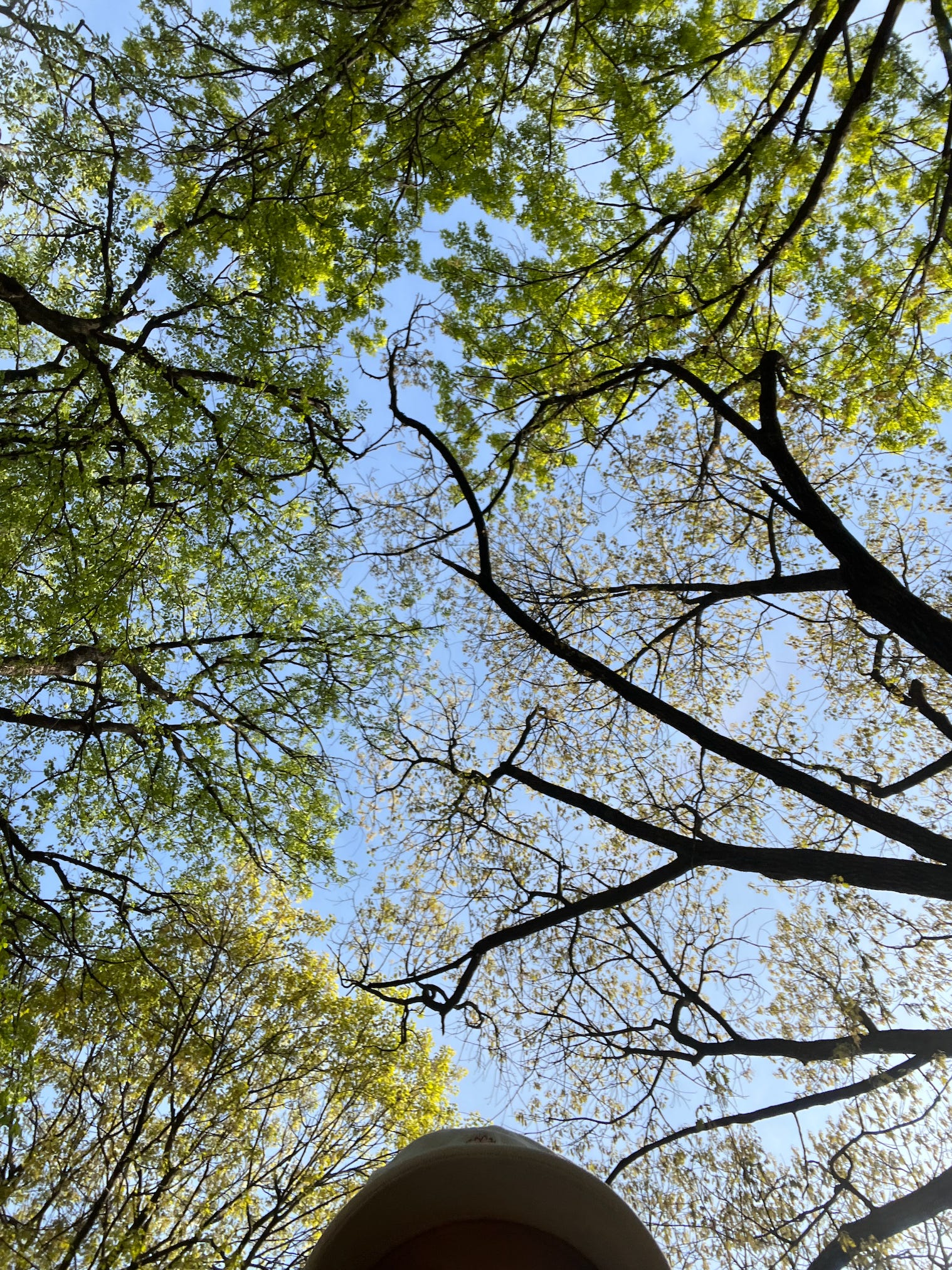
Cue me heading to the park and sitting with the trees.
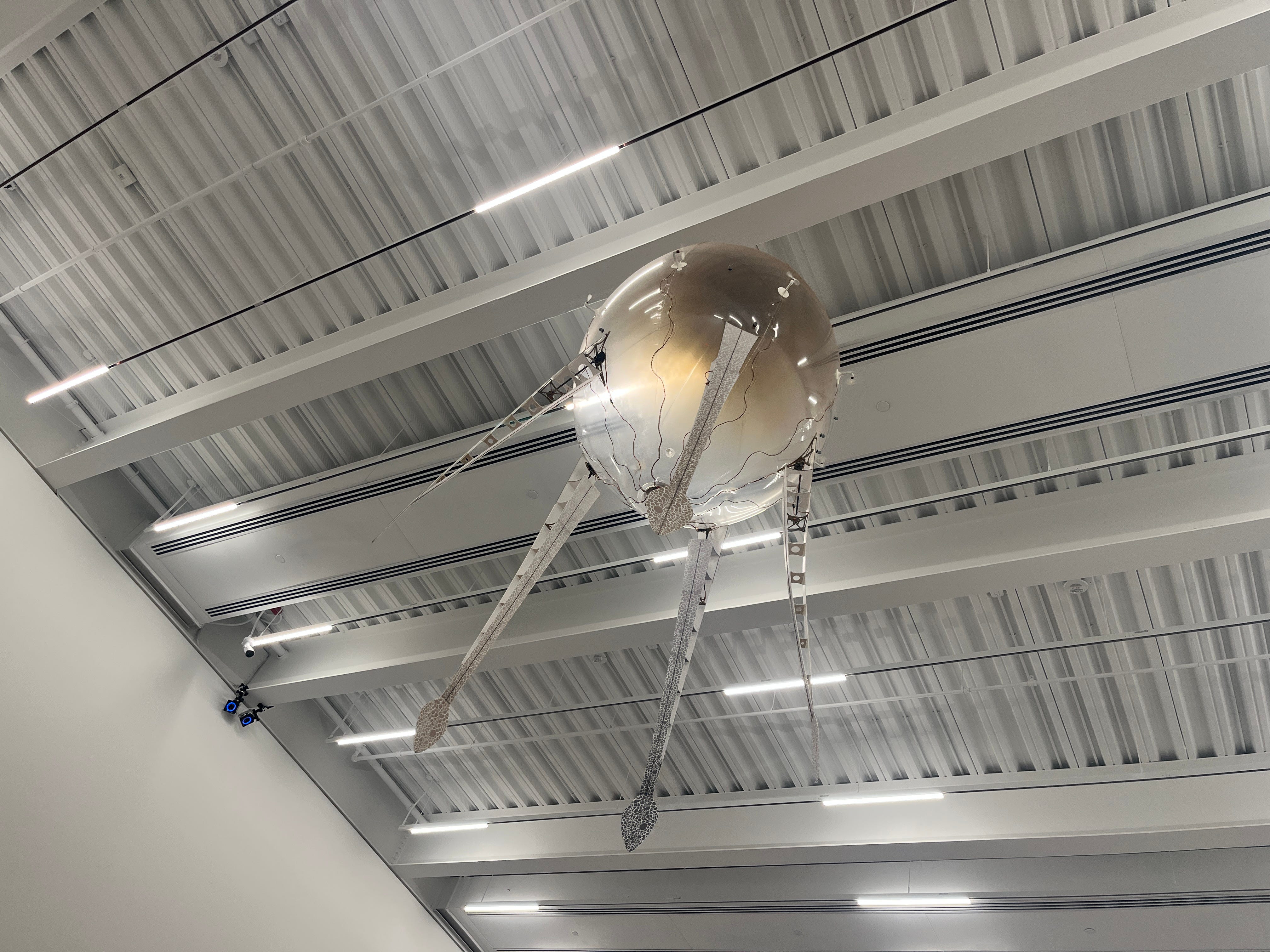
Which had me thinking about the final installation I lingered in the longest: Anicka Yi’s In Love With The World. Over the years I stumbled into a freelance gig where I was editing a lot for Korean artists in translation and so was inadvertently learning a bit, just through fixing a sentence clause or two, about some of the contemporary artists in Korea, who they’re referencing, and what seems to be a shared interest in the fluidity of memory, globalization, and built technologies impact on both.
Anicka Yi was born in Seoul but lives / works in NYC, and her aerobes were some of the most playful, and I would say, hopeful pieces in the exhibit. Her machines are not here to devour us, or to be servants playing us music or vacuuming the floors, but to learn from our shared environment, be responsive, and, ultimately, flexible.
While I don’t think I’d move myself into the class of a techno-optimist, I do think anything that can challenge the strict classification of “human” and push the imagination to think beyond technology as either opponent or something to be mastered might be good to practice.
And, so, I think that’s where I’ll leave it for today—leave the desk—headed for wherever—
j